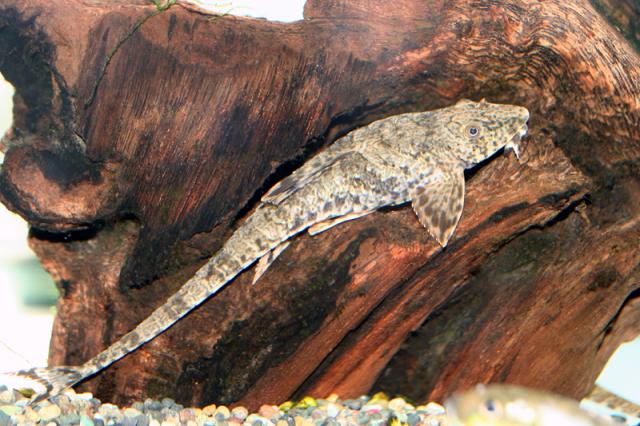
Fish
Whiptail Catfish
Rineloricaria sp.
Origin: Whiptail catfish (Rineloricaria) come from South America, where they inhabit rivers and streams with flow, sand-and-rock beds, and driftwood. In the hobby the name covers several similar species of the genus Rineloricaria.
Also known as: Red lizard whiptail, Rineloricaria sp.
Fact sheet
- Size
- 15 cm
- Lifespan
- 8 years
- Minimum tank size
- 100 L
- Temperature
- 24–28 °C
- pH
- 6–7.5
- Hardness GH
- 2–15 °dH
- Temperament
- Peaceful
- Social behavior
- In pairs
- Swimming zone
- Bottom
- Diet
- Herbivore
- Jumps out
- No
- Eats plants
- No
Overview
The whiptail catfish is a graceful bottom-dwelling armoured catfish with a strongly elongated, flattened body and a long tail 'whip', superbly camouflaged as a twig or root. It is a peaceful, calm fish that lies on driftwood and substrate by day and feeds more actively at dusk, rasping growth. It suits a community tank with peaceful species well. The red selective form ('red lizard whiptail') is popular. It is sensitive to water quality and sudden changes, so it needs stable conditions.
Appearance
The body is strongly elongated and flattened, covered with bony plates, with a long thread-like tail 'whip', 12–15 cm long. Colour matches the substrate — brownish-grey with a mottled pattern, or orange-red in the red form. The sucker mouth is underslung. Breeding males grow bristles (odontodes) on the head and pectoral fins.
Care
A tank of at least 100 L with soft sandy substrate, driftwood, rocks, and cover. Temperature 24–28 °C, pH 6.0–7.5, hardness GH 2–15. Good aeration, flow, and clean water are needed — the species is sensitive to pollution and sudden changes. Tube cover is useful for breeding.
Feeding
A herbivore leaning on growth. It takes vegetable tablets and flakes, blanched vegetables (courgette, cucumber), and algae; animal food only as a supplement. Feed in the evening, once or twice daily.
Compatibility
A peaceful bottom fish. Excellent with small and medium calm species — tetras, rasboras, livebearers, dwarf cichlids, and other catfish. Aggressive and large predatory tankmates are unsuitable. It can be kept in a group.
Breeding
It breeds in the aquarium. The male guards the clutch in a narrow retreat (a bamboo or ceramic tube), fanning the eggs until the fry hatch. Breeding needs soft water and tube cover. Rearing the fry requires vegetable food.
Fun facts
The long tail 'whip' and camouflage colour make the whiptail nearly invisible on driftwood. The trade name 'whiptail' covers about a dozen similar Rineloricaria species that are hard to tell apart. Breeding males grow conspicuous 'bristles' (odontodes).