Fish
Peacock Eel
Macrognathus siamensis
Origin: The peacock eel comes from Southeast Asia — the Mekong and Chao Phraya basins in Thailand, Laos, Cambodia, and Vietnam. It inhabits slow rivers, canals, and backwaters with soft substrate, burrowing into the sand by day.
Also known as: Spotfinned spiny eel, Macrognathus siamensis
Fact sheet
- Size
- 20 cm
- Lifespan
- 10 years
- Minimum tank size
- 150 L
- Temperature
- 24–28 °C
- pH
- 6–7.5
- Hardness GH
- 5–20 °dH
- Temperament
- Semi-aggressive
- Social behavior
- Solitary
- Swimming zone
- Bottom
- Diet
- Carnivore
- Jumps out
- Yes
- Eats plants
- No
Overview
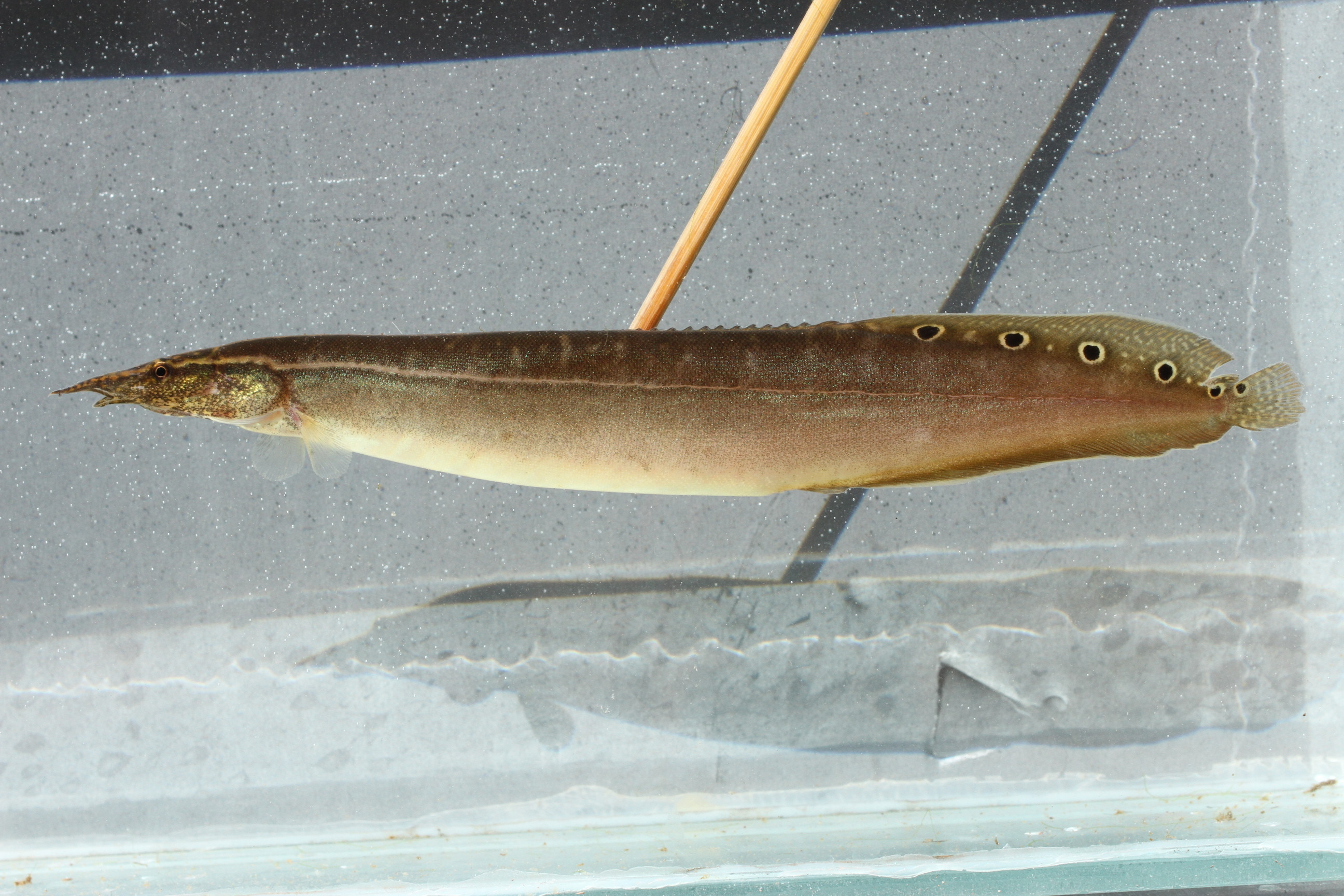
The peacock eel is a graceful spiny eel with an elongated body and a characteristic mobile snout-proboscis it uses to root through the substrate for food. A row of eye-spots ('peacock eyes') marks the body near the tail. It is a nocturnal bottom fish that buries in the sand by day, leaving only the tip of its snout exposed. It is relatively peaceful toward similarly sized fish but may treat small ones as food. It needs soft sandy substrate, cover, and a tight lid. Over time it gets used to its owner and takes food from the hand.
Appearance
The body is strongly elongated, snake-like, and laterally compressed, 18–25 cm long. Colour is brownish-beige with a dark marbled pattern; a row of dark eye-spots ringed with pale edging sits at the tail base. The snout is drawn out into a mobile proboscis with nostrils. The dorsal and anal fins are long and low.
Care
A tank of at least 150 L with soft sandy substrate (the fish burrows), cover of driftwood and pipes, and a tight lid as the eel escapes through gaps. Temperature 24–28 °C, pH 6.0–7.5, hardness GH 5–20. Good filtration and clean water are needed. Sharp substrate is contraindicated.
Feeding
A benthic predator, active at dusk. It takes live and frozen foods — bloodworm, tubifex, earthworms, and small crustaceans. It is trained onto dry food only with difficulty. Feed in the evening after lights-out.
Compatibility
Relatively peaceful toward similarly sized and larger calm fish. It may eat small fish (neons, fry). Companions are medium and large peaceful species of the upper and middle layers. Clashes over cover are possible with its own kind.
Breeding
It very rarely breeds in a home aquarium. In nature spawning falls in the rainy season. Reliable home-breeding methods are few; most fish in trade are wild-caught.
Fun facts
The eye-spots near the tail ('peacock eyes') give the species its name. The fish probes the substrate with its mobile snout-proboscis in search of food. By day the peacock eel buries itself entirely in the sand, leaving only the snout tip exposed.