Fish
Tire-track Eel
Mastacembelus armatus
Origin: The tire-track eel is widespread in South and Southeast Asia — from India and Sri Lanka to Indochina and Indonesia. It inhabits rivers with flow and sand-and-rock beds, burrowing into the substrate by day.
Also known as: Zig-zag eel, Mastacembelus armatus
Fact sheet
- Size
- 60 cm
- Lifespan
- 10 years
- Minimum tank size
- 400 L
- Temperature
- 24–28 °C
- pH
- 6.5–7.5
- Hardness GH
- 5–20 °dH
- Temperament
- Semi-aggressive
- Social behavior
- Solitary
- Swimming zone
- Bottom
- Diet
- Carnivore
- Jumps out
- Yes
- Eats plants
- No
Overview
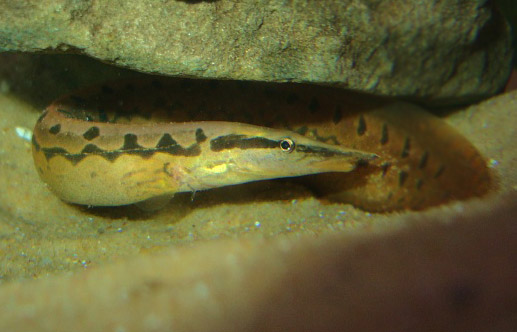
The tire-track eel is a large spiny eel with a characteristic 'zig-zag' pattern along the body resembling a tyre track. It is a nocturnal bottom predator that grows to an impressive size, so it needs a large tank with soft substrate and cover. By day the eel buries in the sand or hides in driftwood, coming out to hunt at dusk. It is peaceful toward fish it cannot swallow but treats small ones as food. An excellent escape artist — the tank must be sealed tight.
Appearance
The body is strongly elongated and snake-like, 50–60 cm long (usually to 50 cm in captivity). Colour is brown with a dark longitudinal zig-zag pattern running the whole length of the body. The snout is drawn out into a mobile proboscis. The dorsal and anal fins are long, merging with the tail. A row of short spines precedes the dorsal fin.
Care
A tank of at least 400 L with soft sandy substrate, large cover of driftwood and pipes, and absolutely a sealed lid. Temperature 24–28 °C, pH 6.5–7.5, hardness GH 5–20. Powerful filtration, flow, and clean water are needed. Sharp substrate is contraindicated.
Feeding
A nocturnal predator. It takes live and frozen foods — earthworms, shrimp, bloodworm, and pieces of fish. Juveniles can be trained onto sinking carnivore pellets. Feed in the evening after lights-out, 3–4 times a week.
Compatibility
Peaceful toward large similarly sized fish, but it eats small ones. Companions are big calm species (large barbs, cichlids, catfish). Clashes are possible with its own kind and similar eels. It needs open space near the bottom.
Breeding
It very rarely breeds in captivity. In nature spawning occurs in the rainy season. Reliable home-breeding methods are almost nonexistent; fish in trade are usually wild-caught.
Fun facts
The zig-zag pattern along the body resembles a tyre track — hence the name tire-track eel. Armatus is often confused with the Thai spiny eel (M. favus). A row of sharp spines precedes the dorsal fin, which the fish uses for defence.