Fish
Stinging Catfish
Heteropneustes fossilis
Origin: The stinging catfish is widespread in South Asia — India, Pakistan, Bangladesh, Sri Lanka, and Nepal. It inhabits ponds, swamps, ditches, and rice fields with oxygen-poor water, surviving drought in the mud.
Also known as: Asian stinging catfish, Airsac catfish, Heteropneustes fossilis
Fact sheet
- Size
- 30 cm
- Lifespan
- 8 years
- Minimum tank size
- 200 L
- Temperature
- 21–26 °C
- pH
- 6–8
- Hardness GH
- 5–25 °dH
- Temperament
- Predator
- Social behavior
- Solitary
- Swimming zone
- Bottom
- Diet
- Carnivore
- Jumps out
- Yes
- Eats plants
- No
Overview
The stinging catfish is a hardy nocturnal predatory catfish with an elongated body and a pair of long sac-like suprabranchial organs (hence the name) that let it breathe atmospheric air. IMPORTANT: this catfish's pectoral spines are venomous and the sting is painful to humans, so handle the fish with great care. It is an extremely tough fish that tolerates poor conditions and can move briefly over land. It suits only experienced keepers in a species tank or with large fish.
Appearance
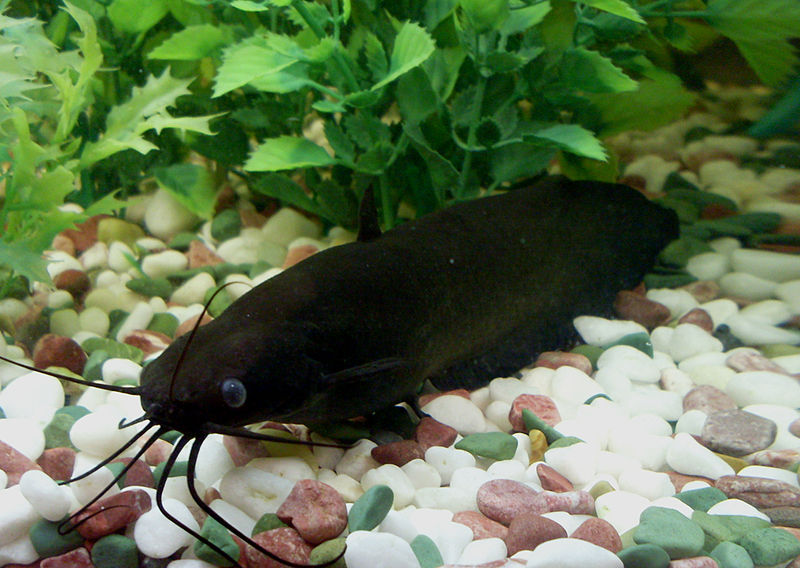
The body is elongated and eel-like, scaleless, compressed toward the rear, 25–30 cm long (larger in the wild). Colour is grey-brown or dark, sometimes with pale longitudinal stripes. The head is flattened with four pairs of long barbels. The pectoral fins have sharp venomous spines. The anal fin is long.
Care
A tank of at least 200 L with soft substrate, cover, free air space above the water, and a tight lid. Temperature 21–26 °C, pH 6.0–8.0, hardness GH 5–25. The species is extremely hardy but appreciates clean water with changes. Handle carefully because of the venomous spines.
Feeding
A voracious nocturnal predator. It takes live and frozen foods — earthworms, shrimp, pieces of fish, bloodworm, and large sinking pellets. It is prone to overeating. Feed in the evening, 2–3 times a week.
Compatibility
A predator incompatible with small fish — it eats anything that fits in its mouth. Keep it singly or with large calm fish in a species tank. Because of its venomous spines and voracity it is unsuitable for a community tank.
Breeding
In nature it builds nests in burrows and the male guards the clutch. In an ordinary aquarium it rarely breeds; in aquaculture it is bred with hormonal induction as a food fish.
Fun facts
CAUTION: the pectoral spines of the stinging catfish are venomous, and a sting causes severe pain and swelling. The sac-like suprabranchial organs act as primitive lungs, allowing air-breathing. The fish can survive in nearly dried-out waters by burrowing into the mud.