Fish
Celestial Pearl Danio
Danio margaritatus
Origin: The celestial pearl danio was discovered in 2006 in small overgrown ponds and streams in northern Myanmar. It inhabits small still waters with dense vegetation, clean and cool water.
Also known as: Galaxy rasbora, Danio margaritatus, Celestichthys margaritatus
Fact sheet
- Size
- 2 cm
- Lifespan
- 3 years
- Minimum tank size
- 40 L
- Temperature
- 20–25 °C
- pH
- 6.5–7.5
- Hardness GH
- 5–15 °dH
- Temperament
- Peaceful
- Social behavior
- Schooling
- Group size
- 8+ individuals
- Swimming zone
- Middle, Bottom
- Diet
- Omnivore
- Jumps out
- No
- Eats plants
- No
Overview
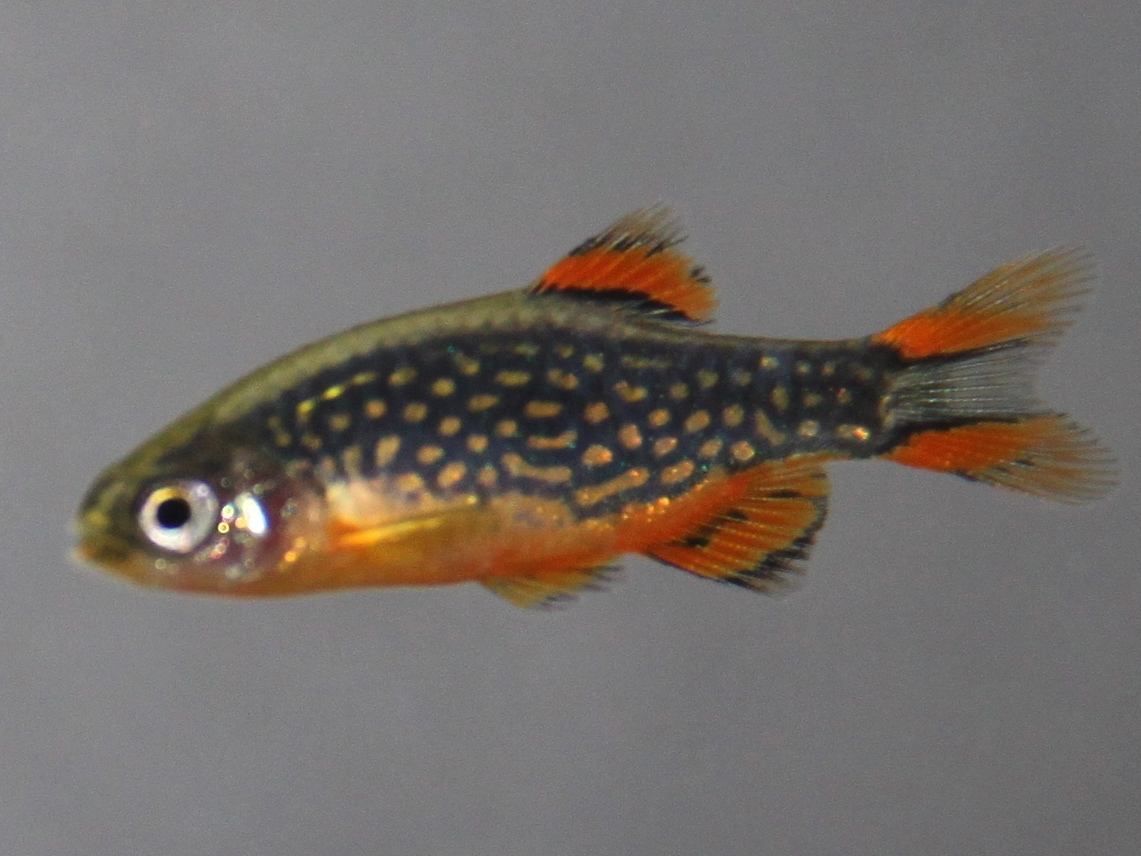
The celestial pearl danio, or galaxy rasbora, is one of the most beautiful nano fish and caused a sensation when discovered in 2006. Its dark blue body is scattered with light-gold 'star' spots, and the fins carry red-orange bars, making the fish resemble a starry sky. It is a peaceful but slightly timid schooling fish for nano aquariums. Males are brighter and perform harmless displays. It likes a densely planted tank with cover and clean, cool water. Because of its popularity the species is widely captive-bred.
Appearance
The body is stocky and rounded, only 2–2.5 cm long. The ground is dark blue-green, scattered with light-gold or pearly round spots. The fins carry bright red-orange bars with black edging (brighter in males). Females are paler, with orange fins lacking black. Males have a reddish belly.
Care
A tank of at least 40 L, densely planted, with calm water and cover. Temperature 20–25 °C (it likes it cool), pH 6.5–7.5, hardness GH 5–15. Clean water, gentle flow, and regular water changes are needed. The timid fish needs thickets for cover.
Feeding
An omnivore with a very small mouth. It takes the tiniest flakes and micro-pellets and live or frozen cyclops, brine shrimp nauplii, and micro-worm. Feed once or twice daily in small portions.
Compatibility
A peaceful but timid schooling fish. Ideal for nano tanks with small rasboras, microrasboras, and dwarf shrimp. Active or large tankmates frighten it. Keep in groups of 8–10 or more so the fish feel confident.
Breeding
An egg-layer with continuous spawning: the female lays single eggs among moss and fine-leaved plants almost daily. Remove the adults or let some fry survive in the thickets. First foods are infusoria and brine shrimp nauplii.
Fun facts
On its 2006 discovery the fish caused such a craze that wild populations were nearly fished out; mass captive breeding saved it. The 'star' pattern gives the name 'galaxy'. The species was originally placed in a separate genus, Celestichthys ('celestial fish').