Fish
Striped Dwarf Catfish
Mystus vittatus
Origin: The striped dwarf catfish is found in South Asia — India, Pakistan, Bangladesh, Myanmar, and Thailand. It inhabits rivers, ponds, ditches, and flooded fields, including slightly brackish estuaries.
Also known as: Striped catfish, Mystus vittatus
Fact sheet
- Size
- 18 cm
- Lifespan
- 8 years
- Minimum tank size
- 150 L
- Temperature
- 22–28 °C
- pH
- 6–7.5
- Hardness GH
- 5–20 °dH
- Temperament
- Semi-aggressive
- Social behavior
- Schooling
- Group size
- 5+ individuals
- Swimming zone
- Bottom, Middle
- Diet
- Omnivore
- Jumps out
- No
- Eats plants
- No
Overview
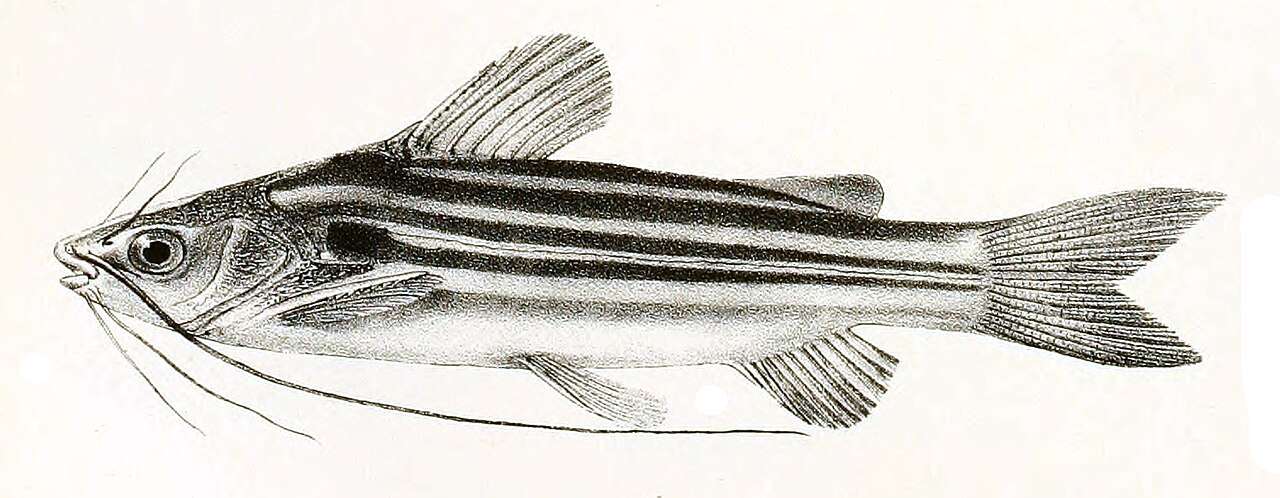
Mystus is an active schooling Asian catfish with an elongated silvery body, longitudinal dark stripes, and four pairs of long barbels. Unlike many solitary catfish, mystus keep in groups and are active at dusk. It is a semi-peaceful fish that gets along with similarly sized species but may treat small ones as food. It needs cover, subdued light, and open swimming space. It is best kept in a group of at least 4–5, or the fish become nervous. An interesting choice for a tank with medium fish.
Appearance
The body is elongated and moderately compressed, 15–18 cm long (sometimes to 21 cm). Colour is silvery with several dark longitudinal stripes along the flanks and a pearly sheen. There are four pairs of long barbels. It has a tall dorsal fin and an adipose fin. Sexual dimorphism is weak.
Care
A tank of at least 150 L with driftwood cover, subdued light, and open space. Temperature 22–28 °C, pH 6.0–7.5, hardness GH 5–20. Good filtration, clean water, and regular water changes are needed. A lid is advisable. The group needs room.
Feeding
An omnivore with a predatory leaning, active at dusk. It takes sinking pellets and tablets, live or frozen bloodworm, tubifex, shrimp, and pieces of fish. Feed in the evening, once a day.
Compatibility
Semi-peaceful toward similarly sized fish, but it may eat very small ones. Keep a group of at least 4–5 with active medium species — barbs, rainbowfish, large tetras. Avoid small fidgety fish and shrimp. It is nervous when alone.
Breeding
It rarely breeds in a home aquarium. In nature spawning occurs in the rainy season. Reliable home-breeding methods are few.
Fun facts
The four pairs of long barbels help mystus orient and find food in murky water and at dusk. Unlike many catfish, mystus keep in groups. The species tolerates the slightly brackish water of estuaries.