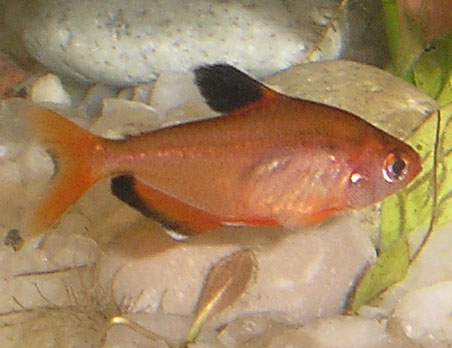
Fish
Serpae Tetra
Hyphessobrycon eques
Origin: The serpae tetra comes from South America — the Amazon, Paraguay, and Guaporé basins in Brazil, Bolivia, and Argentina. It inhabits slow tributaries and backwaters with soft, acidic water and vegetation.
Also known as: Red minor tetra, Jewel tetra, Hyphessobrycon eques
Fact sheet
- Size
- 5 cm
- Lifespan
- 5 years
- Minimum tank size
- 80 L
- Temperature
- 22–27 °C
- pH
- 5.5–7.5
- Hardness GH
- 2–15 °dH
- Temperament
- Semi-aggressive
- Social behavior
- Schooling
- Group size
- 10+ individuals
- Swimming zone
- Middle
- Diet
- Omnivore
- Jumps out
- Yes
- Eats plants
- No
Overview
The serpae tetra is a bright schooling characin of rich red colour with a black spot behind the gills and black-and-white fins. Its striking colour has made it very popular, but it has a quirk: it is a notorious fin-nipper. In small groups or when under-shoaled, the fish nip tankmates' fins and fight among themselves. The solution is a tight shoal of at least 10–12, where aggression is spread within the group. Well kept, it is undemanding and very decorative in a planted tank.
Appearance
The body is diamond-shaped and laterally compressed, up to 5 cm long. Colour is rich red or blood-red; a dark comma-shaped spot sits just behind the gill cover. The dorsal fin is black with white edging, the anal fin red with a black-and-white margin. Males are brighter and slimmer, females fuller. A long-finned form exists.
Care
A tank of at least 80 L, planted, with dark substrate and open space. Temperature 22–27 °C, pH 5.5–7.5, hardness GH 2–15. Clean water, gentle flow, and regular water changes are needed. A dark background and plants bring out the red colour.
Feeding
An omnivore. It takes flakes and small pellets and live or frozen daphnia, cyclops, brine shrimp, and small bloodworm. A varied diet maintains the bright colour. Feed once or twice daily.
Compatibility
Prone to fin-nipping, especially in small groups. Do not keep with slow or long-finned fish (bettas, guppies, angelfish). It mixes well with active similarly sized tetras, rasboras, and danios. A tight shoal of at least 10–12 is essential.
Breeding
An egg-layer. Trigger spawning with soft, acidic water. The fish scatter eggs among fine-leaved plants; remove the adults as they eat the eggs. Fry hatch in a day or two; first foods are infusoria and brine shrimp nauplii.
Fun facts
The serpae tetra is a notorious fin-nipper, and the problem nearly disappears in a large shoal. The red colour intensifies with a varied diet and dark substrate. The species belongs to the complex Hyphessobrycon callistus group, whose members are hard to tell apart.