Fish
Golden Pencilfish
Nannostomus beckfordi
Origin: Nannostomus beckfordi is widespread in northern South America — the Amazon, Orinoco, and Guianas basins. It inhabits slow tributaries, backwaters, and vegetated shallows with soft, acidic water.
Also known as: Beckford's pencilfish, Nannostomus beckfordi
Fact sheet
- Size
- 6 cm
- Lifespan
- 4 years
- Minimum tank size
- 60 L
- Temperature
- 22–28 °C
- pH
- 5.5–7.5
- Hardness GH
- 2–15 °dH
- Temperament
- Peaceful
- Social behavior
- Schooling
- Group size
- 8+ individuals
- Swimming zone
- Middle, Top
- Diet
- Omnivore
- Jumps out
- No
- Eats plants
- No
Overview
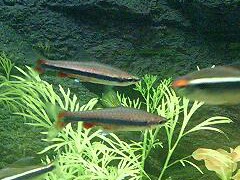
The golden pencilfish is a graceful schooling pencilfish with an elongated body, a dark longitudinal stripe, and reddish fin markings. It is one of the hardiest and most undemanding pencilfish, suited to beginners. In a shoal the males perform harmless displays and become brighter, with red fins. It is a peaceful fish of the upper and middle layers for a planted tank. Curiously, at night its striped daytime pattern changes to a different 'night' one. It looks best as a shoal against a dark background.
Appearance
The body is strongly elongated and pencil-shaped, up to 6 cm long. A clear dark longitudinal stripe runs along the light-gold body from nose to tail; reddish markings sit at the tail base and on the fins. Males are brighter with redder fins. At night the colour changes to a spotted-striped pattern.
Care
A tank of at least 60 L, planted, with calm water and dark substrate. Temperature 22–28 °C, pH 5.5–7.5, hardness GH 2–15. Clean soft water, gentle flow, and regular water changes are needed. Floating plants and diffuse light bring out the colour.
Feeding
An omnivore with a small mouth. It takes small flakes and micro-pellets and live or frozen cyclops, brine shrimp nauplii, micro-worm, and fine daphnia. Feed once or twice daily in small portions.
Compatibility
A peaceful schooling fish. Excellent with small characins, rasboras, dwarf cichlids, corydoras, and shrimp. Large or aggressive tankmates are unsuitable. Keep in shoals of 8–10 or more.
Breeding
An egg-layer. It scatters eggs among fine-leaved plants and moss; remove the adults as they eat the eggs. Fry hatch in a day or two; first foods are infusoria and brine shrimp nauplii.
Fun facts
Like other pencilfish, the golden pencilfish changes its striped daytime pattern to a different 'night' one at night. It is one of the easiest pencilfish for beginners. The males' red fins are brightest during tournament displays.