Fish
Gold Neon Tetra
Paracheirodon innesi
Origin: The gold neon tetra is a selective colour form of the common neon tetra (Paracheirodon innesi), developed in the aquarium hobby. The parent species comes from the soft, acidic blackwaters of the upper Amazon in Peru, Colombia, and Brazil.
Also known as: Paracheirodon innesi 'Gold'
Fact sheet
- Size
- 4 cm
- Lifespan
- 5 years
- Minimum tank size
- 60 L
- Temperature
- 20–26 °C
- pH
- 5.5–7.5
- Hardness GH
- 2–15 °dH
- Temperament
- Peaceful
- Social behavior
- Schooling
- Group size
- 8+ individuals
- Swimming zone
- Middle
- Diet
- Omnivore
- Jumps out
- No
- Eats plants
- No
Overview
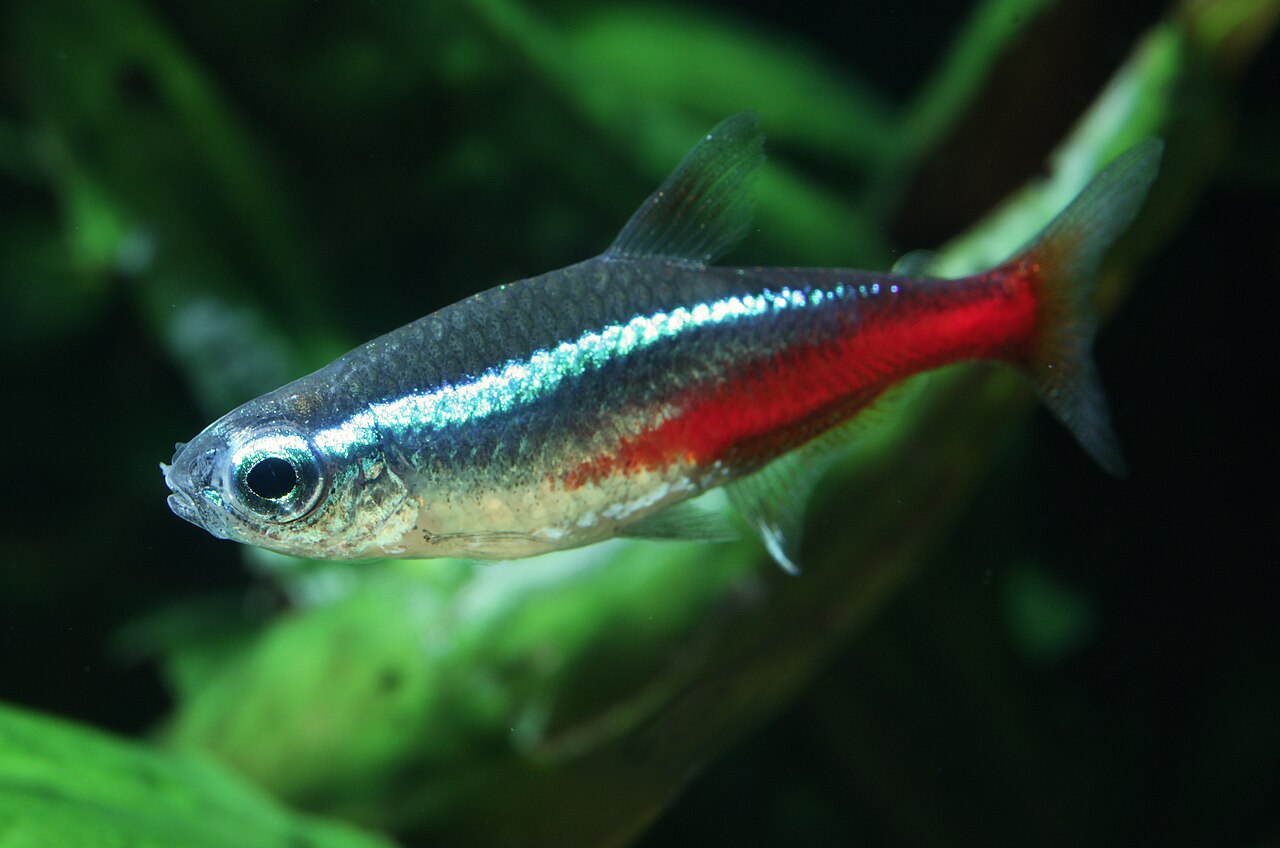
The gold neon tetra is a popular colour form of the neon tetra with a golden-platinum body in which the standard bright blue stripe is reduced or takes on a golden sheen. In care and behaviour it is identical to the common neon: a peaceful schooling fish for a planted tank with soft water. The golden colour arises from a partial lack of pigment (leucism) and looks especially striking against a dark background in a tight shoal. An excellent choice for a peaceful community tank.
Appearance
The body is spindle-shaped, 3.5–4 cm long. Colour is golden-platinum with almost none of the usual blue; a reddish zone remains near the tail, and the blue-green stripe is reduced to a golden sheen. Males are slimmer, females fuller. The golden tone intensifies with age and over pale substrate.
Care
A tank of at least 60 L, planted, with dark substrate and soft water. Temperature 20–26 °C, pH 5.5–7.5, hardness GH 2–15. Clean water, a mature stable tank, and regular water changes are needed. Neons are sensitive to immature water, so do not add them to a new tank.
Feeding
An omnivore with a small mouth. It takes small flakes and micro-pellets and live or frozen daphnia, cyclops, brine shrimp nauplii, and micro-worm. Feed once or twice daily in small portions.
Compatibility
A peaceful schooling fish. Excellent with small peaceful characins, rasboras, corydoras, dwarf cichlids, and shrimp. Large or predatory tankmates (which would eat a neon) are unsuitable. Keep in shoals of 8–10 or more.
Breeding
An egg-layer; breeding is of medium difficulty. Trigger spawning with very soft, acidic water and shade (the eggs are light-sensitive). Remove the adults. Fry hatch in about a day; first food is infusoria.
Fun facts
The golden colour is the result of partial leucism (a lack of pigment), not a separate species. As with the common neon, the fish look especially striking in a tight shoal against a dark background. Neons are prone to 'neon tetra disease' (pleistophorosis), so cleanliness and quarantine matter.