Fish
Venustus Cichlid
Nimbochromis venustus
Origin: Nimbochromis venustus is a cichlid endemic to Lake Malawi. Unlike the rock-dwelling mbuna, it is a predatory haplochromine of open sandy zones, where it hunts near the bottom by ambush.
Also known as: Giraffe cichlid, Nimbochromis venustus
Fact sheet
- Size
- 25 cm
- Lifespan
- 10 years
- Minimum tank size
- 400 L
- Temperature
- 24–28 °C
- pH
- 7.6–8.6
- Hardness GH
- 10–25 °dH
- Temperament
- Semi-aggressive
- Social behavior
- Harem
- Group size
- 4+ individuals
- Swimming zone
- Middle, Bottom
- Diet
- Carnivore
- Jumps out
- Yes
- Eats plants
- No
Overview
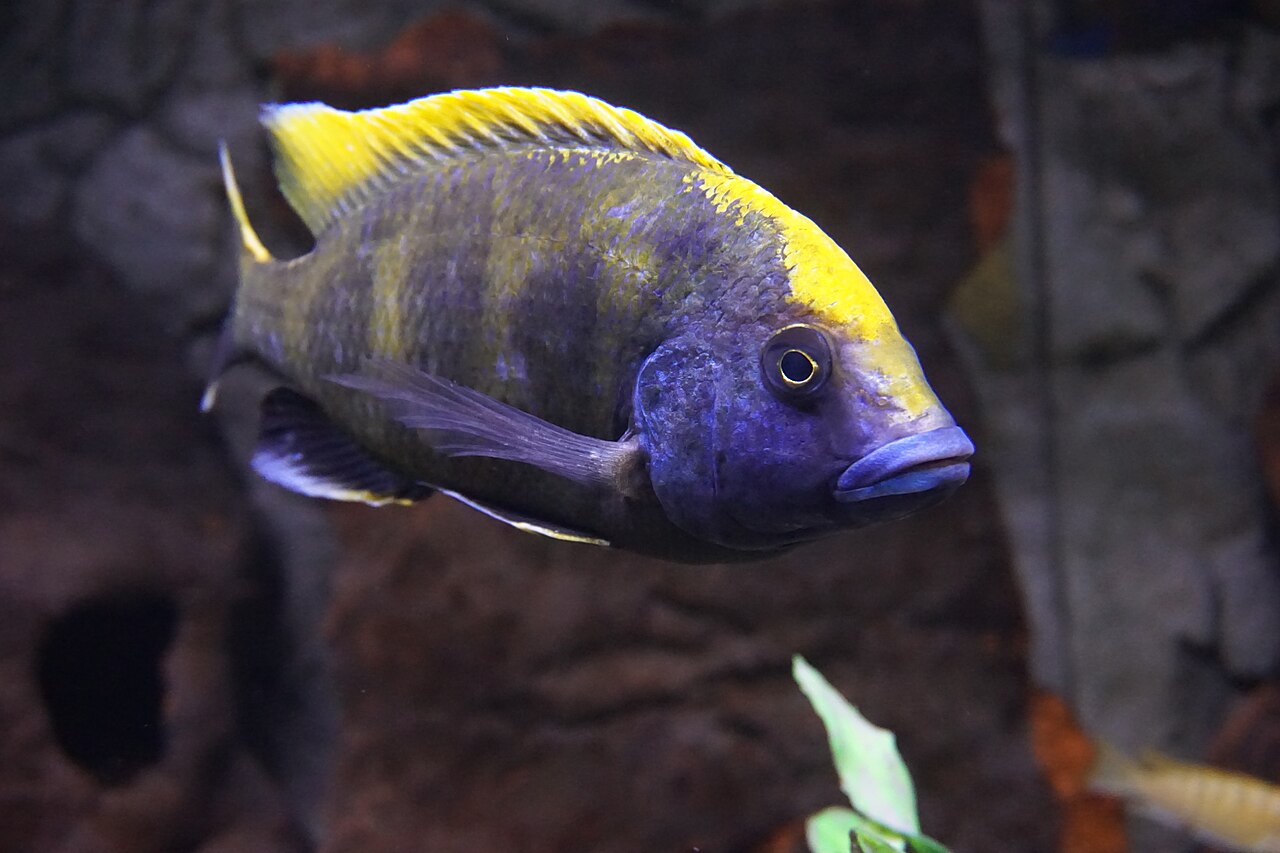
Nimbochromis venustus is a large, striking predatory Malawi cichlid with yellow-and-blue colour and a characteristic marbled-blotched ('giraffe') pattern, which earns it the name giraffe cichlid. Dominant males develop a bright blue head and a yellow back. It is a large fish needing a spacious tank with a sandy bottom, rocks, and hard alkaline water. A predator, it treats small fish as food. It suits keepers of large Malawi cichlids.
Appearance
The body is elongated and sturdy, up to 25 cm long. Large dark-brown blotches scatter over a pale yellow body, forming a marbled 'giraffe' pattern. Dominant males develop a bright blue mask on the head and a yellow back. Females and juveniles are blotched without blue. It has the large mouth of a predator.
Care
A tank of at least 400 L with a sandy bottom, groups of rocks, and open space. Temperature 24–28 °C, pH 7.6–8.6, hardness GH 10–25 — hard, alkaline water. Powerful filtration, aeration, and regular water changes are needed. A tight lid — the fish is active and may jump.
Feeding
A predator. It takes quality predatory-cichlid pellets, frozen and live shrimp, mysis, and pieces of fish. Do not feed mammalian meat. Excess fatty protein is harmful. Feed small portions once a day.
Compatibility
A predatory cichlid: it eats small fish. Keep as a harem with other large Malawi cichlids of similar size and temperament. Do not combine with small or peaceful species. Space is needed to reduce aggression.
Breeding
The female is a mouthbrooder. After the male's display on the sand, the female takes the eggs into her mouth and incubates them for about 3 weeks, then releases the fry. Breeding is easy with a harem and a spacious tank.
Fun facts
The marbled-blotched pattern gives the species the name giraffe cichlid. In nature venustus hunts by burying in the sand and ambushing small fish. The dominant male stands out with a bright blue head.