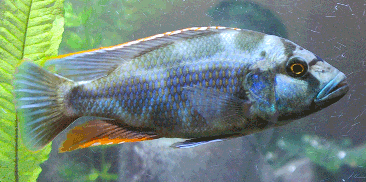
Fish
Livingston's Cichlid
Nimbochromis livingstonii
Origin: Nimbochromis livingstonii is a cichlid endemic to Lake Malawi. A predatory haplochromine inhabiting the transition zones between sand and rock, it is known for an unusual hunting method — 'playing dead'.
Also known as: Sleeper cichlid, Kalingo, Nimbochromis livingstonii
Fact sheet
- Size
- 25 cm
- Lifespan
- 10 years
- Minimum tank size
- 450 L
- Temperature
- 24–28 °C
- pH
- 7.6–8.6
- Hardness GH
- 10–25 °dH
- Temperament
- Predator
- Social behavior
- Harem
- Group size
- 4+ individuals
- Swimming zone
- Middle, Bottom
- Diet
- Carnivore
- Jumps out
- Yes
- Eats plants
- No
Overview
Nimbochromis livingstonii is a large predatory Malawi cichlid famous for a unique hunting tactic: the fish lies on its side on the bottom and stays still, mimicking a dead fish, and when curious small fish approach the 'carcass' it suddenly snatches them. For this it is nicknamed the 'sleeper'. Colour is a white-blue ground with large dark blotches. It is a large predator for a spacious tank with hard alkaline water. It treats small fish as prey. It suits keepers of large Malawians.
Appearance
The body is elongated and sturdy, 20–25 cm long. Large irregular dark-brown blotches scatter over a bluish-white body. Dominant males develop a blue sheen and a blue head. Females and juveniles are more blotched. It has the large mouth of a predator.
Care
A tank of at least 450 L with a sandy bottom, groups of rocks, and open space. Temperature 24–28 °C, pH 7.6–8.6, hardness GH 10–25 — hard, alkaline water. Powerful filtration, aeration, and regular water changes are needed. Space is needed for hunting and to reduce aggression.
Feeding
A predator. It takes quality predatory-cichlid pellets, frozen shrimp, mysis, and pieces of fish. Do not feed mammalian meat. Excess fatty protein is harmful. Feed small portions once a day.
Compatibility
A predatory cichlid: it eats small fish. Keep with other large Malawi cichlids of similar size. Do not combine with small or peaceful species. Space is needed.
Breeding
The female is a mouthbrooder. After spawning she incubates the eggs for about 3 weeks, then releases the fry. Breeding is easy with a harem and a large tank.
Fun facts
Livingstonii is one of the few fish that hunt by 'playing dead': it lies on its side mimicking a carcass and snatches approaching fish. It is named after the explorer David Livingstone. The 'death' tactic works in the aquarium too, alarming new owners.