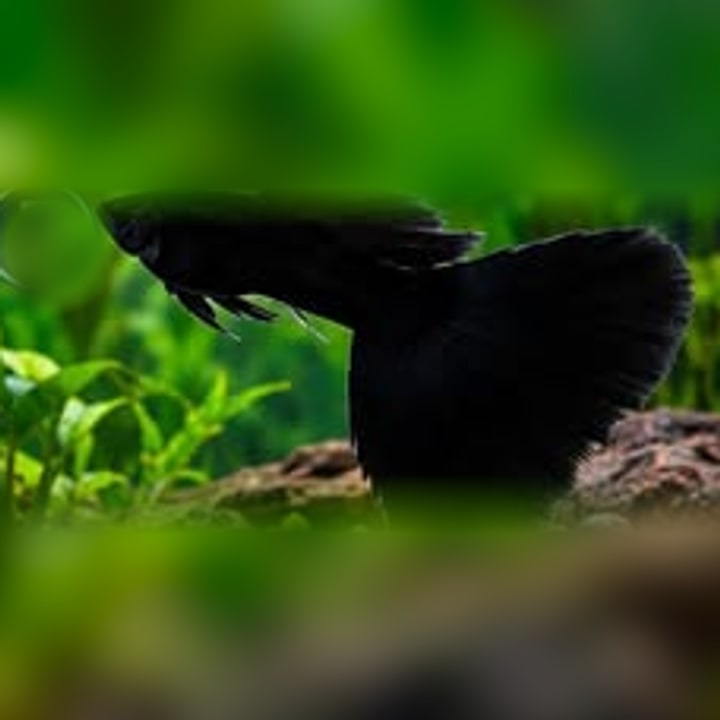
Full Black Thailand
Poecilia reticulata
Origin: Венесуэла, Тринидад, Тобаго, Барбадос, Бразилия, Гайана
Also known as: Full Black Thailand
Fact sheet
- Size
- 7 cm
- Lifespan
- 3.5 years
- Minimum tank size
- 20 L
- Temperature
- 24–26 °C
- pH
- 7–8.5
- Hardness GH
- 10–25 °dH
- Temperament
- Peaceful
- Social behavior
- Schooling
- Group size
- 3+ individuals
- Diet
- Omnivore
- Jumps out
- Yes
Overview
A selectively bred form of the common guppy (Poecilia reticulata). The name is a trade name used by breeders and shops rather than a formal standard. Care and breeding are the same as for the species.
Appearance
The fish is completely black — body and all fins. The tail is large and fan-shaped.
Care
Shared with the species: Guppy
Guppies are adaptable but thrive best in tanks of at least 40 liters (10 gallons) for a small group, with larger volumes providing greater water stability. Ideal water temperature is 22–28°C (72–82°F), pH 7.0–8.0, and moderately hard water (dH 9–19). Because they are shoaling fish, they should never be kept alone—groups of five or more are strongly recommended, ideally with a ratio of one male to two or three females to reduce harassment. A well-planted aquarium with gentle filtration and regular water changes (20–30% weekly) is ideal; guppies tolerate gentle surface agitation for oxygenation. They are sensitive to sudden temperature drops and to elevated ammonia or nitrite levels, so only cycled, stable tanks should house them.
Feeding
Shared with the species: Guppy
In the wild, guppies are omnivores that consume algae, diatoms, plant fragments, detritus, zooplankton, aquatic insect larvae, and small invertebrates, with algae typically making up the largest portion of their diet. In the aquarium they readily accept high-quality flake food and micro-pellets as a staple, and benefit greatly from regular supplementation with frozen or live foods such as brine shrimp, daphnia, bloodworms, and micro-worms. A varied diet enhances color intensity and overall health. Adults should be fed small amounts twice daily; fry require very fine food—baby brine shrimp nauplii, infusoria, finely ground flakes, or commercial fry powder—several times a day.
Compatibility
Shared with the species: Guppy
Guppies are generally peaceful community fish that coexist well with many other small, similarly-tempered species. Ideal tankmates include platies, mollies, swordtails, peaceful tetras (neon, ember, rummy nose), corydoras catfish, and rasboras. However, males may occasionally nip the fins of slow-moving fancy-finned fish, and guppies themselves are easily stressed or eaten by larger or aggressive species such as cichlids and large barbs. When keeping guppies with other livebearers, it is worth noting they can crossbreed with Endler's livebearers to produce fertile offspring, which may be undesirable if preserving strain purity.
Breeding
Shared with the species: Guppy
Guppies are livebearers, meaning females give birth to fully formed, free-swimming fry rather than laying eggs. Gestation lasts 20–60 days depending on temperature and conditions. A single female can produce 2–200 fry per brood (typically 30–60), and remarkably, females can store sperm in their ovaries for up to eight months, continuing to produce multiple broods from a single mating. A heavily planted tank or a spawning box protects fry from being consumed by adults; well-fed adult guppies usually tolerate fry if there is sufficient plant cover. Fry are independent from birth and reach sexual maturity in approximately 3–4 months. Selective breeding programs use these short generation times to rapidly establish and stabilize new strains.
Fun facts
Shared with the species: Guppy
Guppies share an unusual defense mechanism with few other fish: when a predator approaches, their irises darken instantly from silver to jet black, directing the predator's strike toward the head rather than the vulnerable body center, allowing a 'matador-like' escape. The species possesses 23 pairs of chromosomes—the same number as humans. Guppies introduced around the world for mosquito control have unfortunately become invasive in many regions, outcompeting native fish species and disrupting local ecosystems, illustrating the unintended consequences of biocontrol programs.