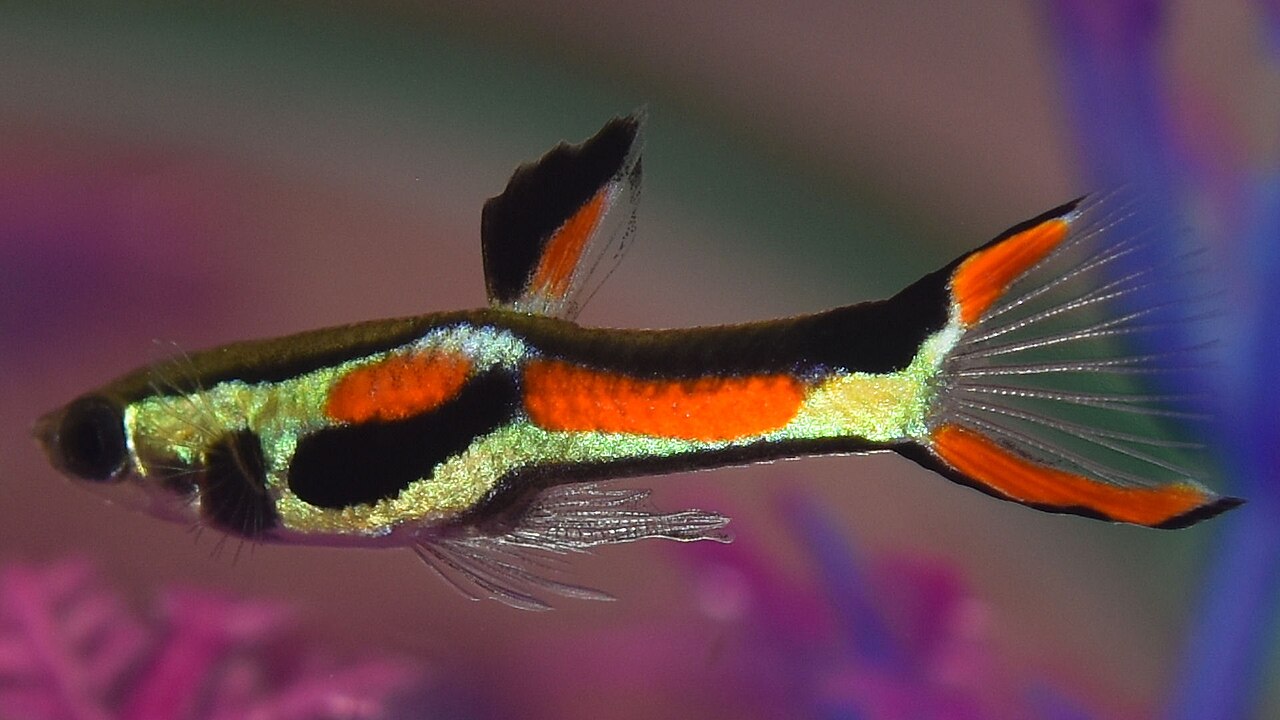
Variety of Endler's Livebearer
Cumana
Poecilia wingei
Origin: Laguna Patos and connected waterways, Venezuela
Also known as: Endler's guppy, Endler
Fact sheet
- Size
- 4 cm
- Lifespan
- 4 years
- Minimum tank size
- 40 L
- Temperature
- 24–30 °C
- pH
- 6.5–8.5
- Hardness GH
- 8–35 °dH
- Temperament
- Peaceful
- Social behavior
- Schooling
- Group size
- 6+ individuals
- Swimming zone
- Middle, Top
- Diet
- Omnivore
- Jumps out
- Yes
- Eats plants
- No
Overview
The original population that John Endler found in 1975 and that was first called "Endler's livebearer".
Pictured is a fish collected from Laguna Patos and then line-bred into the "black bar" phenotype.
Wild populations are valued as "pure" lines: crossing with common guppies produces fertile offspring but dilutes the gene pool, so breeders avoid it.
Appearance
A male with a greenish-gold metallic body, large orange patches and a broad black bar on the side. The upper and lower edges of the tail are orange with black borders.
Care
Shared with the species: Endler's Livebearer
- Volume: from 40 l for a small colony; base dimensions from 45 × 30 cm.
- Temperature: 24–30 °C. The species is hardy and will live at room temperature without a heater.
- Water: pH 6.5–8.5, hardness 8 to 35 °dGH. Endlers tolerate hard, slightly alkaline water well.
- Keep them as a group with more females than males, otherwise males harass the females constantly.
- Plants are essential: dense growth along the edges gives females and fry somewhere to retreat.
- Cover the tank — like guppies, Endlers jump.
- Keep the flow gentle and change part of the water weekly.
Life expectancy is around 4 years.
Feeding
Shared with the species: Endler's Livebearer
Omnivorous. In the wild they feed on zoobenthos and detritus, and graze algae and micro-organisms off plants.
In the aquarium they take almost any food of a suitable size. Because the mouth is small, flakes are worth crushing. Some vegetable matter in the diet is necessary. Live and frozen foods — daphnia, cyclops, baby brine shrimp — are taken readily.
Compatibility
Shared with the species: Endler's Livebearer
Peaceful, but too small for a general community tank with larger fish. Good companions are dwarf corydoras, small rainbowfish and peaceful tetras.
Males are peaceful towards each other, while females can behave territorially.
The key restriction: Endlers must not be kept with common guppies. The two species interbreed freely and the offspring are fertile, so a pure line is lost within a couple of generations. This is exactly how the trade filled up with hybrids sold as peacock, snake or tiger Endlers.
Breeding
Shared with the species: Endler's Livebearer
Breeding is extremely easy — given males and females, the colony grows on its own.
- Females give birth roughly every 23–24 days.
- A brood holds 5 to 25 fry; English Wikipedia gives a range of one to thirty or more.
- Males begin to show colour at 3–5 weeks and reach full coloration over their first six months.
- Females can reproduce from about two months of age.
Giving birth is stressful for the female, and some do not survive a large brood.
Adults rarely hunt the fry, but dense planting still helps them.
Fun facts
Shared with the species: Endler's Livebearer
- The species name honours the Danish geneticist Øjvind Winge (1886–1964), while the common name comes from John Endler, who rediscovered the fish in 1975.
- Sixty-eight years passed between the first collection in 1937 and the formal description in 2005.
- Hybrids with the common guppy are fertile, so pure lines are scarce in the trade — most shop "Endlers" are of hybrid origin.
- The IUCN Red List classifies the species as Endangered.